Frank Lake

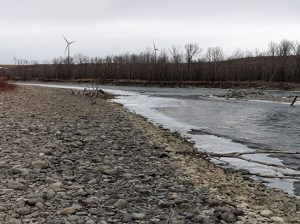
The Frank Slide and what has become of Frank Lake. Picture taken November 2021

In the early morning of April 29th, 1903 one hundred twenty million tons of rock thundered down from Turtle Mountain, slammed into the Crowsnest River and valley throwing up and out centuries of deposited silt, killing up to 90 people and destroying a significant portion of the town of Frank before rumbling up the hills on the other side of the valley. From the picture above one could be forgiven for thinking all that rock some how flew over the Crowsnest River. A small barrier to the river was formed by rocks at the east end of the slide area. The subsequent displacement of the silty valley floor and the impoundment created a small lake which, unsurprisingly, was named after the town of Frank.

Back in the 70’s Frank Lake looked more like this photoshopped image and stumbling through the rocks at the base of Turtle Mountain one could dap or cast his flies or lures and catch some nice rainbows. More importantly for me was the fact that the lake was a great depository for silt coming in from the tributaries to the river upstream. So on many of the days the river was running the colour of chocolate milk through the Pass I could put in some where downstream of Frank Lake and fish cleaner water at least for a short time anyway.

It was inevitable that some day the lake would silt in and look more like the river it was before that disastrous event of 1903 but there is little doubt in my mind the emptying /cleaning of Blairmore’s water supply dam on York Creek in the 80’s and the Lost Creek fire of 2003 hastened that process. What happens in the head waters of a river system can and does have far reaching downstream impacts even when we can not see the impact as we can in the lake created by the fall of Turtle mountain.

Frank Lake did provide some good fishing opportunities but it was the river upstream from the slide where I spent much of my time fly fishing in the 70s and early 80s for the bright rainbows that would often eagerly eat my offerings despite my presentation. It was also in the late 70s that I decided it would be smarter to save money and get exactly the kind of flies I wanted when I wanted them. Boy, was it ever naive to believe I would save money and learning to tie effective flies with no guidance other than the odd book I could acquire on trips to the city was difficult, time consuming, and frustrating to say the least but I stuck with it. There were flys I read about and desired that simply were not readily available.

I began my efforts the winter of 78 but it wasn’t until late summer / early fall of the following year that I finally tied a pattern that actually looked like a fly pattern pictured in in Flies of the Northwest put together by the Inland Empire Fly Fishing Club. I quickly took that fly, an American Coachman, down to the river just above Frank Lake and as luck would have it one of the nicer rainbows that lurked beside a big rock ate that fly on one of my first few casts. It didn’t matter that the fly was a streamer, which was supposed to sink, but instead floated over the likely lie when the fish hammered it. I was hooked. Later that week I gave all my store bought (many $$ worth) flies to a friend I worked with.
It is a Journey

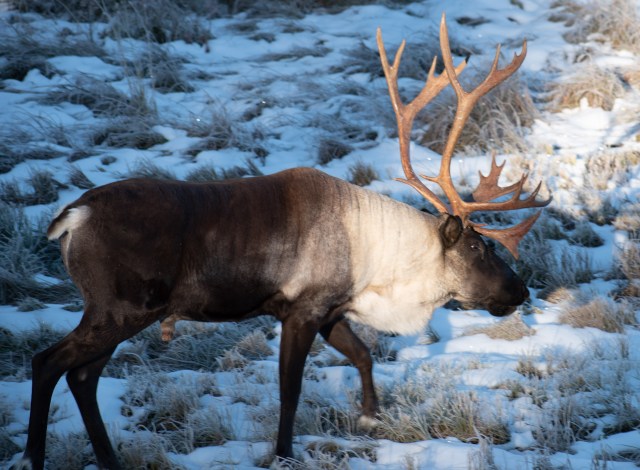
Bull caribou on highway 40 south of Grande Cache taken mid September

Mid September 2018 my destination was Okotoks Alberta. The first half of the journey would take me from Grande Cache, Alberta down Hwy 40 across many small creeks and bigger rivers including the Berland, Wildhay, and the Athabasca. Along highway 16 crossing the Mcleod River to Hwy 22 and onto a secondary highway bypassing Drayton Valley and crossing the North Saskatchewan. I have crossed that river quite a few times always looking upstream to what appeared to be nice big corner hole. As I was leaving Grande Cache early I was expecting to to have time to check that enticing looking corner out (which I was sure would hold walleye and pike) and, if not, I would at least have a chance to use my Spey rod on that large river.

On a trip you will arrive at your destination whether the journey is enjoyable or not. This day I enjoyed the journey. It was a cool early fall morning with the remnants of an early snow left on the ground. About a half hour south of Grande Cache on hwy. 40. I spotted a bull caribou slowly meandering in the cool blue pre sunrise light feeding in an open clearing. On hwy 40 there are no shoulders so I pulled into the ditch opposite the bull grabbed my camera and sat on the near side of the highway hoping he would make into the small bit of sunshine hitting a portion of the clearing. Luck was with me. He didn’t spook and slowly made his way into the beam of early sun and I was able to get one shot with his front quarter and antlers in the light. Nice start to the trip.

I arrived at the bridge over the North Saskatchewan after lunch and the day had warmed considerably. I didn’t anticipate wading so it was just shorts, wading shoes, and neoprene socks rather than waders. After stringing up the long rod and tying on a light marabou Clouser and headed up to fish the corner I had been eyeing for quite a few years. After a short walk I saw what couldn’t be seen from the bridge. One would need a boat to able to cross a wide deep channel of the river to access an island around which another channel flowed. The corner was inaccessible.

I’m left with a very wide straight section of water which is as good place to play with the long rod as any. Like one would do on a steelhead stream I cast (as best i could) swung the fly, step down and repeat the process. Could have sworn I felt a couple of tiny hits, likely from tapping the bottom but my imagination felt it was little bites. Continuing down I reached a pretty wide back eddy on my side. A long cast across hitting the seam between river flow and eddy I had a solid hit. I was using a rod strong enough for steelhead but still the fish put a respectable bend in the rod. I was excited. Probably hooked a good walleye on the North Saskatchewan. That thought was short lived once I got the fish close. It was a decent brown! Not big but nice enough.

Two casts later to the same seam and another fish on. This one felt stronger and of course I was sure it had to be a bigger brown. Got the fish close and it continued upstream. I didn’t get a great look but could see it was very fat with huge scales. Lake white? I had no idea. Finally got it close enough to see and its big yellow eyes stood out. A first for me. Goldeye! I have always wanted to get some on a fly and today completely unexpectedly I reach that milestone. One more was landed before I continued to my destination.

I did reach my destination. The journey though was the most enjoyable part of that day. Caribou captured on camera, a brown, and two goldeye. A great day, thoroughly enjoyable. That is what fly fishing is. You may have becoming an expert fly fisher set as your destination but the journey is what gets you there. Unlike a trip, if you don’t take pleasure in all that the journey is you will not reach your destination.

Winter, a good time to fish and start writing

Bow River Below Hwy 2

Those of us living in Southern Alberta are fortunate to have 3 very good rivers to fish throughout the winter months and up til now the winter of 2020/2021 has been very nice to us fly fisher folk. Many days this winter were warm enough to get on the water and not worry about the guides on our rods freezing every couple of minutes. Then just as February comes and we believe spring is almost upon us a vicious polar vortex engulfed us in absolute frigid temperatures. Temps cold enough to keep even those hardy ice fishers home. Now seems to be a very good time to start a writing. Retired now I was fortunate to get out the last nice day before the deep freeze came and ensured we follow the covid social distancing guidelines.

Oldman River

Sometimes the best thing about fly fishing is not just finding new water in an old familiar setting.

Nor is it about fish caught. Nor those that got away.

Some times the best thing about fly fishing is those little, unexpected, almost magical things that remind us that we are just one piece of something bigger. That fill us with the wonder we experienced in days long gone by when we first started exploring the wondrous natural world around us. This day was one of those where the fishing was overshadowed by the wild.

Walking back to the Jeep on the ice flanking the river, again and again, movement under the ice in the shallow water caught my eye and disappeared as quickly as it showed. Ginger, my springer, and I were being followed. Fish don’t behave this way.

Then the family of very efficient hunters showed themselves. Mom, Dad, and two young otters. They swam, porpoised, and came looking. Challenging Ginger (who was smart enough to point from a distance) to play. Sometimes the best things about fly fishing isn’t the fishing at all.